Tuesday, November 13, 2012

Chef Jocelyn


Now that we are half way through our Basic Pastry training, I think it is safe to speak for my classmates when I say that we really like our main chef: Chef Jocelyn.  Girls in my group often giggle about how adorable he is, not in a romantic way, but in the same way that one would smile at kids in Halloween costumes or foreign students who are lost on campus (before you help them, of course).

No, Chef Jocelyn is cute in his own unique way that is composed of a few elements: 1) his humor, 2) his accent and grasp of the English language, and 3) his look.  These things combined make him the perfect chef for a large group of Basic Pastry students like us, and makes our 3-hour classes pass quickly, usually with at least a few instances of laughter, even if they are just for courtesy.

His Humor

The Chef has a very specific kind of humor that usually involves making word puns in English.  They usually don’t work out very well, but when that happens, we (or at least those of us in the first two rows) force a little giggle, smile out of kindness and appreciation for his trying, or laugh a little at his reaction to his own joke.  I really appreciate that he makes jokes, and they’re usually some of my favorite parts of the demo, whether they’re funny or not.  They include things like calling his rolling pin his “Rolling Stones” repeatedly, then giggling to himself.  He has also adopted the Star Trek quote, “He’s dead, Jim” and uses it to break the news to students that they need to start over in practical.  The same day he adopted that quote, he repeated, “I’m the Doctor!  Doctor Who?  I’m the Doctor!  Doctor Who?” as he did his rounds in the lab kitchen, stopping to giggle every few rotations.

As I’m sure you can imagine, a pastry demo generally has a lot of quiet time in which we watch the chef repeat tasks until he is out of dough, all the pans are prepared, etc.  Chef Jocelyn likes to fill this quiet time, which we appreciate.  These sidebars are sometimes about the chemistry or mechanics of what will happen in the pastry, but usually they are about different subjects like cycling or cell phones or technology as a whole.  One of my favorites was about fast food restaurants, which I have included in the recordings below.

His Accent and Grasp of the English Language

I have been blessed with the natural and uncanny ability to easily decipher the spoken word of someone who speaks English as a second (or third or fourth) language.  I’m not sure why, but from a young age, I have just always been able to understand accents very easily.  Everyone from my professors from Turkey and Germany and Algeria and Mongolia to the Frenchmen I met while studying in Chambéry.  That talent, combined with my knowledge of the French language, has made it almost natural to understand the chefs here.  Chef Jocelyn, though, evidently is not always easy to understand, as I often hear my classmates asking each other to repeat things from class or complain about how difficult it is to understand him.

Just because I can understand his accent doesn’t mean that I can ignore it – it is fantastic!  Words like “butter” and “flour” and “counter” have distinctly French endings, words like “temperature” get an extra syllable, and words like “coagulation” and “vapor,” which are very similar in French, get to stay in French.

He understands and speaks English very well, considering it isn’t his native language, and I can’t think of a time that I simply did not understand him.  Sometimes he has to get a little creative with his words and it doesn’t come out quite correctly (like explaining yeast as being a “microscopic mushroom”), but we understand what he means.

I take an audio recording of each lesson, just in case I miss something or want to review later, and I re-recorded a few samples of his accent for you.  Is he easy to understand?  If not, I've included a cheat sheet at the end of the post.  Let me know how easy (or not) he is to understand -- I'm really curious!  Here are a few samples (click on the titles to open in another window, click on the large orange play button):


His Look

Chef Jocelyn looks like a pastry chef.  It’s undeniable!  Usually he wears clear-rimmed classes and he smiles ALL the time.  He’s pretty skinny, which one would not expect from a seasoned pastry chef, but he explained it to us:  Pastry chefs stay skinny because of all the hard work that goes into successful doughs.  And I can say – it is truly exhausting.


Cheat Sheet

The transcripts of the first three recordings of Chef's accent, just in case he is difficult to understand:

Microscopic Mushroom

“So the…the yeast as you know is uh…it’s a mushroom.  It’s a microscopic mushroom. So the yeast is alive.  By comparison with baking powder: baking powder is chemical.  Uh?  K?  So that means yeast need a process before to be active.  If you put like this in the dough like you do with baking powder, it does not work.  To active the yeast, you need to feed the mushroom.  Imagine it’s a mushroom; it’s a vegetable.  So he needs food…for the, the best condition to survive he needs food.  He needs humidity, and he need temperature.”

Big Mac

“Fast food.  The success of fast food.  Two idées: serve very fastly and fresh.  Period.  That’s all.  If you eat, if you buy a Big Mac now, leave it on the counter and you eat it in one hour, you puke.  K?  This is the biggest success of the food chain is that: freshness.  Not the ingredients, no.  The cheapest ingredients.  But, C’est la vie.”

Pâte à Choux


“Now I’m going to incorporate the eggs.  The eggs are crucial in this recipe because the steam; because I did not dry all the water from the recipe, ok?  I just dry a part of it.  The water that is inside the panade is going to be transform in steam in oven that will push the pâte à choux up.  Then the eggs are going to coagulate.  Ok?  And when there is no steam anymore inside the pâte à choux, the eggs, after coagulation, will be hard.  That’s what makes the shell of pâte à choux.  Ok?  So, it’s necessary to dry the panade, but not too much.  If you over-dry the panade, your pâte à choux will never rise.  You understood?  There is no liquid, there is no water in the panade anymore so it doesn’t puff.  You don’t have steam.  K?  Voilà.  Alors, you can press again, a little bit on your bowl.  The quantity of eggs that I have is approximatively 10, 15% too much.  K?  So that means you can add first half of it.  There is no problem if you add half of it.  But then at the end you have to do it very very very carefully.  You adjust the correct consistency.  I will tell you the correct consistency.  So I have 8, uh, 10 eggs to incorporate, so I can add 5 eggs without over-dosing.  Oui.  I have no risk since I add only 50% of the quantity; I have no risk to over-dose.  That’s only at the end.  The risk is at the end.”

Monday, November 5, 2012

Classic and Modern Sauces

This past Saturday (November 3rd), the school had arranged a fabulous trip:  A bus trip to Prince Edward County to explore wine country, tasting wine and cheese at three different stops and returning to the school nearly 13 hours later.  It was right up my alley, and reminded me so much of my time in France, so I went to visit Sara in the office to give my RSVP.

When I told Sara why I was there, she looked a little sad.  The last spot had just been filled on the trip, so there wasn’t any room for me to go.  She put me on a waiting list, just in case someone had to cancel their seat, and wished me luck.

Just as I got to the door, she called me back in.  “Since you’re free that day,” she said, looking back and forth at me and at her computer screen, “would you be willing to be a Demo Assistant for the ‘Classic and Modern Sauces’ short course?”  I thought about it.  I didn’t really think I was qualified to do that…but how could I say no to a question worded like that?  “No, Sara, I would be absolutely unwilling to help out.  I’ll sit at home and hope someone can’t go on the awesome trip to wine country.”  So, I agreed, reluctantly, to spend the day at school helping people make sauce.

Perhaps it was a little naïve of me, but I figured that this demo wouldn’t be very full.  I mean, if I saw a class entitled “Classic and Modern Sauces” on a list of courses, I think I’d automatically rule that one out of my preferences.  After all, how much application do French sauces really have in a home kitchen?  And what fun would it be to return home with three containers full of sauce?  I was pretty sure it would be a small class.

I showed up, as directed, one hour before the demo was to begin.  My instructions were to help the chefs with anything they asked, and I was a little nervous.  The cuisine chefs are notoriously more intense than the pastry chefs, and I was definitely (though the office disagreed) not qualified for this.

To my pleasant surprise, one of the two chefs was Chef Hervé, my favorite pastry chef, and the other was Chef Didier, a cuisine chef with whom I have been acquainted, and who has always been polite to me.  Chef Hervé laughed a little at the thought of a pastry student helping with a cuisine demo, but said that I could come in handy, and asked me to set bottles of water on the table and run the camera for the demonstration portion.  Can do, Chef!

When Chef Didier was ready to begin the demo, he walked over to me and told me, politely, that it was unnecessary that I was by the camera, and that he would rather Chef Hervé do it.  I resigned to the back of the room with the other three students (all cuisine upper-classmen) and took notes the entire demo.  I realized why Chef Didier wanted Hervé behind the counter with him:  this is the one time he could get away with teaching a Demo in French, so he wanted Chef Hervé to be his translator.  The class was a great opportunity to practice my French, and I found that I would have done a pretty good job translating for Chef Didier if he had asked me to.

The demo was interesting, but not terribly captivating.  The Chef made five different sauces, with the students (adults, mostly in their 30’s to 50’s) doing three in their practical.  I paid close attention and took really detailed notes, fully aware that students would be asking me questions about how to perform sauces that I had never tasted, nevertheless successfully mastered.

After tasting the Chef’s finished products (which were all amazing, of course), the other students and I cleaned up the kitchen and prepared to lead our two classes (each about a quarter of the people in the demo) to their lab kitchens.  I had been chosen to work in Chef Didier’s kitchen, since it is widely known that he much prefers to speak in French because his English isn’t great, and I let it slip to one of the cuisine students that I am fluent. 

As soon as I led the class to the kitchen, Chef is really upset, quickly explaining to me (in French) that the chicken stock and flour is nowhere to be found, and that it was supposed to already be at each student’s station.  Not liking the fact that he was already upset, I quickly descended into the production kitchen, ready to haul a huge bucket of chicken stock and a bag of flour back up to the lab kitchen.  Lucky for my tiny muscles, though, I discovered the problem:  the students who set up the labs simply forgot our second tray of ingredients in the production fridge.  So I hauled the tray (which was huge and probably 35 pounds) to the kitchen and saved the day.

The students were great.  Some of them were very comfortable in this group-kitchen situation, and others were clearly not.  Chef Didier (like many of the cuisine chefs) has a tendency to throw pots and smack the counter and other loud gestures, and every time this kind of thing happened, half of the room jumped and their eyes got big.  My job was easy and difficult, all at once.  I was to walk around the room, checking on everyone’s sauces, and give the students whatever they needed.  If they needed something like an extra bowl or another egg yolk, life was good.  If they needed advice and direction, I had a choice: guess according to what I saw in the demo or call the Chef (who was always busy) over to my student.  Luckily, the choice was usually pretty easy, and no one failed a sauce because of my misdirection.

A few students burned themselves, so a good portion of my time was spent tending to their wounds, which was a legitimate function for me in the cuisine kitchen.

When everyone had finished, the other student in my kitchen and I cleaned up, chased students down who forgot things in the kitchen, returned unused ingredients to the production kitchen in the basement, and went home.  It was a long and tiring day, lasting from 10:30am to 4:00pm, but it was fulfilling.  Though I don’t think I would volunteer to help with another cuisine demo (I maybe got a little lucky with the simplicity of sauce), I would definitely do a pastry one.

The best news in all of this: Not only did I get this great experience and some great conversation with two chefs, but there were so many people on the waiting list for the Wine and Cheese trip that they scheduled a second one in a few weeks, and I am automatically on the list.  Score!

Big Scary Knife Kit

They kindly added the Le Cordon Bleu logo
to the outside of our bags, which I love
Our knife kits are a huge part of our learning experience at Le Cordon Bleu.  I love mine, but I would be lying if I said that I wasn’t afraid of it at all.  It’s basically attached to me the entire time that I’m in school for a practical, and it makes me feel safer when I walk home in the dark. 

During our orientation, we gathered in a lab kitchen for a Chef to go through our knife kits with us, making sure we had every piece and knew what each knife was generally used for.  As pastry students, we sort of got a little bonus: Many of the knives in our kit are used solely for cuisine cooking, so we didn’t need to bring those to school.  They’re not “free” (since the price of the kit was included in our tuition), but they are extra.  These, for example, aren’t used in our pastry classes:
From left to right: Trussing Needle (for tying up poultry),
Turning Knife (for "turning vegetables), De-Boning Knife,
Meat Fork, and Cleaver.
Even though we don’t need all the knives, that doesn’t mean that my kit is empty.  I’ve added some extra tools from home that come in handy in pastry classes: a few rubber spatulas, a ruler, disposable piping bags, my smaller icing spatulas, and an extra plastic scraper.

A few included tools we use the most:
  • Electric Scale, for measuring all of our ingredients, as well as dough portions.
  • Paring Knife, for general cutting needs, like measuring butter
  • Plastic Scraper, an incredibly handy tool foreign to most of us before we started our classes, this little guy is used for everything from cutting and mixing dough to scooping ingredients and scraping bowls clean
  •  “Super Slicer”, technically a bread knife (though “Super Slicer” is its real name), this serrated wonder is used to torte cakes.  We’ve only used it once, but I can tell that it will become more and more common soon.
  • Piping Bags, in two sizes, we were given reusable ones with a variety of tips.  I still prefer disposable, and finally got some Wilton ones to keep in my bag along with these.
  • Little Fruit Tools, including a peeler, corer, two zesters, and a melon baller.
  • Whisk
  • Magnets, for sticking the parchment paper to the baking sheets in the oven, since our ovens have a fan inside

A tour of the inside of the kit:

My fruit tools: big zester, melon baller, peeler, little zester,
corer, tongs

The scale and paring knife: the first two tools
I always grab at the beginning of every
practical class, because I know I'll need them

The "Pastry Compartment," complete with
kitchen scissors, my rubber spatulas, tasting
silverware, and a zipper pocket with whisk,
brush, thermometer (which is still unused),
magnets, and plastic scraper (at the top left)

The big knives.  From right to left: Super Slicer, Chef Knife,
knife sharpener, Offset Spatula, Spatula, Random-Knife-I-
Keep-In-There-Just-In-Case
The kits are heavy!  Mine weight approximately 22 pounds without the meat cleaver and other cuisine knives, so I use the shoulder strap when I need to carry it around.  It’s pretty convenient – especially when we climb the four flights of stairs to our usual practical lab kitchen.


The knives are SO sharp.  At least two of my friends have cut themselves because the knife slipped while putting it back in the blade protector and the blade just had the tiniest whisper against their skin, resulting in a substantial cut.  I have yet to cut myself, but it’s bound to happen soon.  Luckily, in pastry we use our knives for things like cutting butter off the block to measure it, scrape chocolate shavings, divide dough into appropriately-sized portions, and score designs on the top of pastries. 

Each knife has the brand's sticker
on the handle

Each blade is engraved with this logo
The bag is made of water-proof (and lemon tart-proof, as I discovered a couple weeks ago) fabric, has three zipper pockets that cause the bag to fold flat, and has the Le Cordon Bleu and Wüsthof logos on the front.  I can tell that the bag, along with all of the super-sharp knives, is going to last a very very long time.  I’m glad – I can tell that the knife kit will grow on me, as I have already become kind of attached to it.  I’m trying to figure out how to pack the essentials to bring home over Christmas to bake for my friends and family, as I realized that there’s no way I’d be able to carry it onto a plane.


Sunday, October 28, 2012

Pastry Update: First Quarter

After Week 3 at Cordon Bleu, we're already a quarter of the way through our first semester!  (Wow time flies!)  Before arriving, I often wondered what kinds of pastries the chefs would start us on.  After all, how basic is "Basic?"  So, here is a review of our first three weeks' pastries.  The basic of the basic!

Leçon 1
Basic Pastry starts with doughs, and with reminding us that we really are doing everything by hand - no tools allowed (excluding our scale and knife kit).  So, we dove into the first week with a demo of basic flour, butter, and egg-based doughs: Pâte Brisée (for savory pies), Pâte Sablée (for large tarts and for shortbread cookies), Pâte Sucrée (for tartlettes, or small tarts), Pâte à Foncer (for sweet pies), and Damier (checkerboard-style cookies made of chocolate and vanilla shortbread dough).  The practical was only the Brisée, Sablée, and Sucrée; and I did really well!  See: my Petits Sablés Nantais (shortbread cookies) look pretty good!
The chef's shortbread cookies (in the center)


My shortbread cookies


Leçon 2

Chef Jocelyn demonstrating whipped doughs:
Our first experience whipping by hand
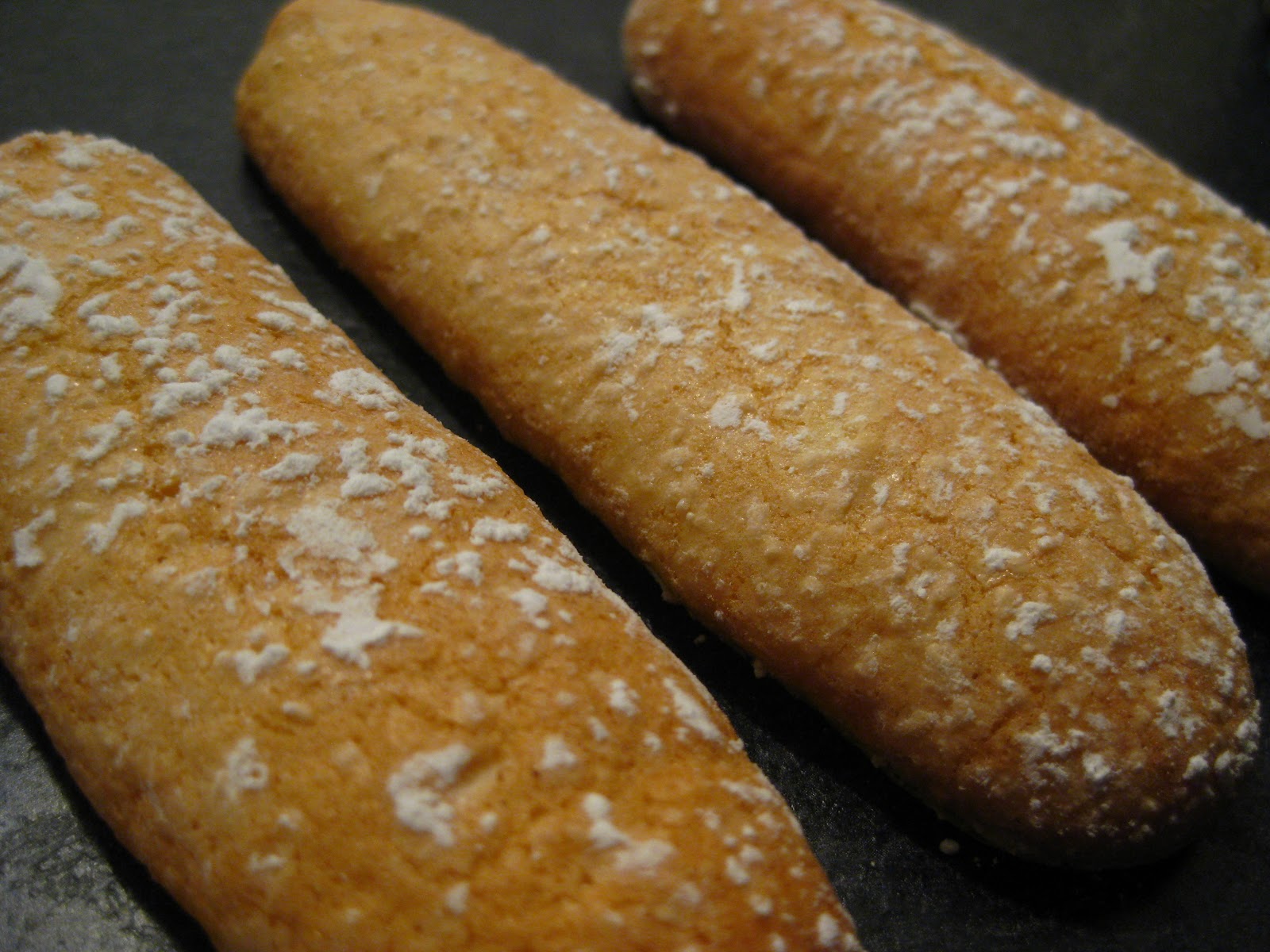
We continued the week with Whipped Doughs, machines still outlaws in our kitchen.  These included Génoise (sponge cake), Biscuits à la Cuillère (Lady Fingers), Biscuit Roulé (spiral cake with jam), and Dacquoise.  In the practical we tried our hands at Génoise and Lady Fingers, learning exactly how under-developed our pastry muscles were.  We even purchased huge balloon whisks to aid in our hand-whipping of egg whites into a meringue, but even then it was excruciatingly exhausting.  My results were pretty nice, though, and Chad loves the Lady Fingers so much that he wants me to teach him how to make them.  Great!


The Chef's Genoise (right) and Spiral Cake (left)


The Chef's Dacquoise (usually used as the bottom for cakes)


My Lady Fingers
The Chef's Lady Fingers

Chad thinks they are so tasty!  (These are mine, again)
Leçon 3

Italian Meringue meant the return of the
huge balloon whisk
Next up were the creams: the bases of many a French pastry.  The Cream Demo consisted of Crème Chantilly (whipped cream with icing sugar and vanilla), Crème Patissière (pastry cream), Crème Anglaise (English custard cream), Crème Bavaroise (Bavarian Cream), Crème d’Amandes (Almond Cream), Crème au Beurre (French Buttercream), Ganache, and three types of Meringue: French, Italian, and Swiss.  The demo was almost hard to watch, knowing that each of these creams required a lot of whipping, and that the Balloon Whisk was going to return to our practical.  The Meringues, especially, would be difficult.  In the practical we did the Italian Meringue twice, the Pastry Cream, Crème Anglaise, Ganache, and Almond Cream.  All of mine turned out very well, even the Italian Meringue.

Italian Meringue involves whipping hot syrup with egg whites.  “Doing everything by hand” also means “No thermometers allowed,” so when it came time to test our syrup for the correct temperature (121 Celcius), we did it by hand by scooping hot boiling syrup out of the pot with our fingers (which had been iced).  It was scary, but we all made it through blister-free.

Leçon 4
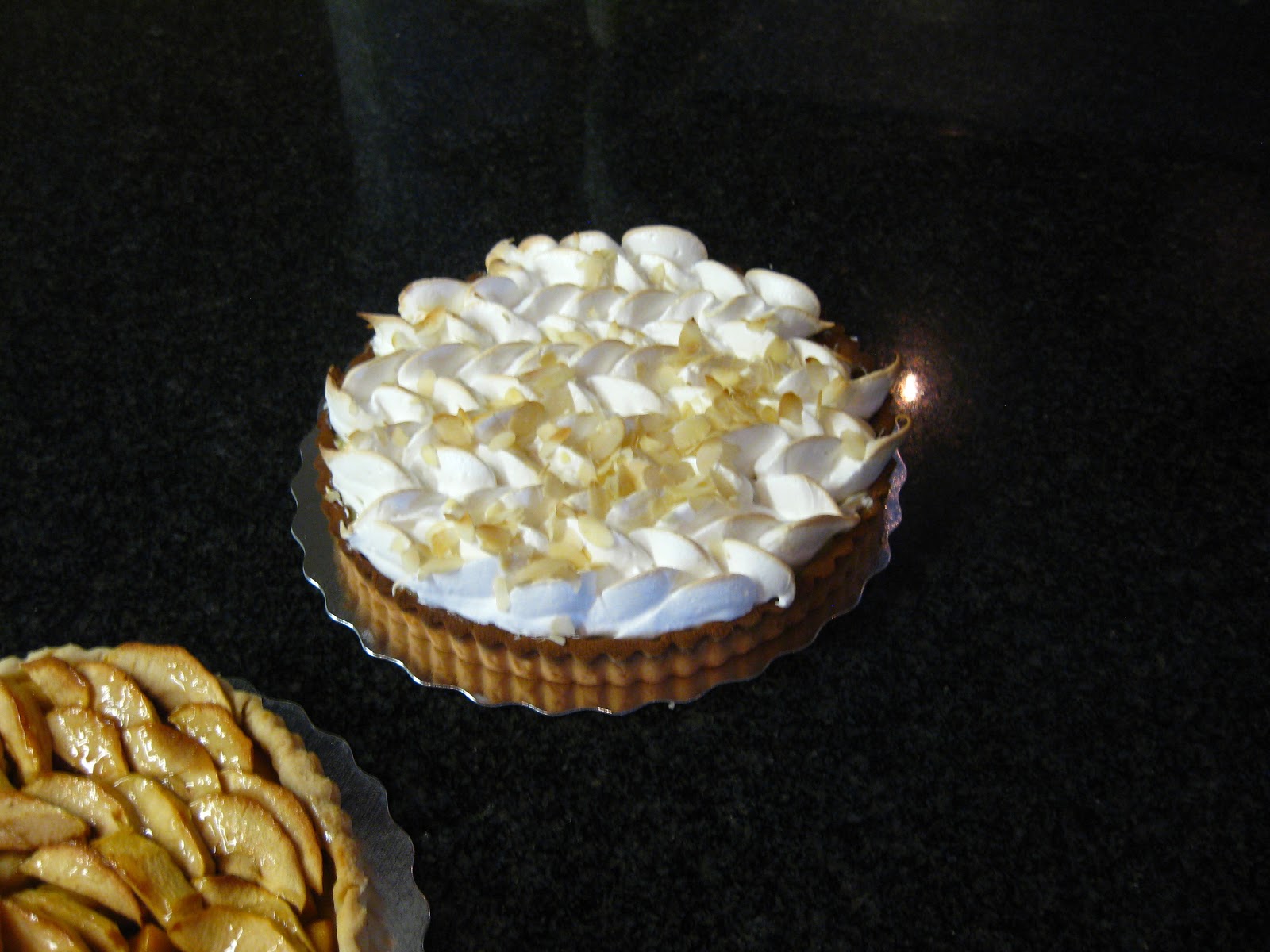
Lesson 4 was the first time we would actually assemble something in our practical, rather than just making the elements of a pastry.  Lesson 4: Tarts.  Chef Jocelyn demoed three different tarts with three different techniques: Tarte au Citron (lemon tart with meringue), Tarte aux Pommes (apple tart without cinnamon – score!), and Tarts aux Fraises (strawberry tart).  Our practical was simply the Lemon Tart.

The Chef's Apple Tarts

The Chef's Lemon Tart
The Chef's Strawberry Tart
The practical went very well, initially.  We were to make most of the pieces: the crust (from Leçon 1), the lemon cream, and the Italian Meringue from the previous lesson.  The tart also contains almond cream, which we had saved from a previous practical.  For me, the crust went smoothly, my almond cream looked awesome, and the lemon cream turned out really well.  When it came to the Meringue, though, something just wasn’t working out for me.  I ended up failing it twice before it finally worked out, with the help of the chef.  I’m glad I wasn’t the only one – about half of the class had to re-do their meringue at least once, and many of us ended up using our third meringue of the day.  My piping was nice, though, and the tart turned out really well.
What was left of my Lemon Tart after dropping half of it 

The Chef came around and judged my tart very positively:  The crust could’ve been baked for a few more minutes, but it wasn’t bad, and my lemon cream had a great taste.  My piping looked really nice, and the meringue was a great color.  The positive critique made all the meringue whipping (and my really sore upper body) worth it, so I packed the tart in my cake carrier to take home.
The piping was nice, though!

Now, there’s something that has to happen at least once to everyone, and that day was my day: when I lifted my cake carrier, the pie slid out onto the ground.  Whoops!  I was glad it happened after the Chef had made his critique, and I caught it quickly enough to save half of the pie from falling.  It was still a lot to clean up off of my shoes and pants and knife bag; but it meant that Chad and I only had half of a pie to eat, which was a plus in the end (though it was super delicious!)


Leçon 5
Our fifth lesson was on rising doughs, and we were demoed Croissants, Brioches (white French bread), Pâte Feuilletée (puff pastry), and Savarin aux Fruits et à la Crème (a light little shortcake with pastry cream, fresh fruit, rum syrup, and Chantilly cream).  

Rising doughs mean extra-careful time management,
being sure they all get time to rise properly

Savarins: the Chef's favorite!  They were really really tasty
In our practical, we just made the dough for Croissants, Brioches, and Puff Pastry (or “Flaky Dough,” as Chef Jocelyn says).  The dough was really fun to make, as it involved whacking the dough against the counter, swinging and slapping it, for 8-10 minutes straight.  It was loud in the kitchen, and we were all having a good time.  We simply refrigerated our finished doughs in anticipation for…

Leçon 6
Lesson 6, our most recent lesson, was the finishing and shaping of the doughs we made the previous day.  The Chef showed us how to do Danoises (Danishes), Pain aux Raisins (little raisin rolls, kind of like cinnamon rolls), Pains aux Chocolat (chocolate croissants, a favorite of my classmates when I studied in France), and a few different shapes for Brioche: Brioche Tressée (braided), Brioche Tête (“Little Head Brioche”), Brioche Nanterre (balls of dough in a loaf pan), and Couronnes des Rois (“King’s Crown” Brioche).  We would practical many of these, and I was really looking forward to it.

The Chef's raw Danishes
My raw Danishes (Ignore the reject I made
with the leftover dough, bottom center)
The Chef's raw Raisin Rolls (top), Chocolate Croissants(Center), and Croissants (by his hand)
My raw Raisin Rolls (top), Chocolate Croissants, and Croissants
The practical was the most fun, by far.  We removed our dough from the fridge and set to recreate the Chef’s shapings.  With the croissant dough we made traditional Croissants (which I accidently measured in inches rather than centimeters, so mine were monstrous), Pain au Raisins, and Pains aux Chocolat.  With the Brioche, we did the Brioche Tressée, Brioche Nanterre, Brioche Tête, and turned the rest of our dough into little balls with course sugar on top.  It was a great time, and the Chef was really proud of my work!  I even had enough leftover croissant dough to make fresh Danishes for Chad and I the next day.  Tasty!
The Chef's Brioches.  Round one at the bottom: Couronnes des Rois;
Left center: Braided; Right center: Nanterre; Top left: Brioche rolls
with candied fruits; Top right: "Mousseline Brioche"
My Brioche Nanterre
My Braided Brioche

The Chef's smaller pastries.  From right to left: Little Head Brioche
(None of them could stand like they are supposed to -- they're tricky),
Cinnamon Rolls, Brioche Balls with Course Sugar, Raisin Rolls, Croissants, Danishes

My Little Head Brioches:  All of them could stand!
My best Little Head Brioche -- The Chef was proud
My Brioche Ball with Course Sugar
My Pain au Chocolate
My Pain au Chocolat - Glad I came home with 8 of them!
My big Croissant - measured in inches rather than centimeters 
My Little Raisin Rolls - they look pretty darn good!  The Chef
was really proud of these, too.
The Chef's Danishes
My Danishes (again -- ignore the loser on the center right)
Uff Da!  It was quite the busy practical, with plenty of bread
to take home
With my Cake Carrier crammed full, I still had to carry some
pastries that didn't fit

Halloween in Ottawa


Halloween is my favorite holiday.  I love everything about it – the décor, the weather, the dressing up (especially the dressing up!), and the excuse to wear black lipstick.  I’ve always been a Goth-at-Heart, so Halloween has been my socially-acceptable reason to get a little dark.  Exhibit A:
Halloween 2011, before my hair was actually black

This year, though, Halloween falls on a busy time, precariously close to the deadline for Chad’s thesis.  So I started to look for a little Halloween event that we could walk to that wouldn’t take a lot of time so that we could get Chad back to work shortly, while still enjoying the season.  After all – I insisted that we pack our Star Trek uniforms so that we could go somewhere this week, so it would be kind of sad not to.

The spooky Heritage Building
Online, I found a list of a ton of things to do in Ottawa for Halloween: a Zombie walk, vintage Halloween party, Trick-or-Treating in the malls, and pumpkin patches.  One event sounded great and close: the Mayor’s Halloween party!  It was within walking distance and featured a haunted house fit for children (tame enough for me – I get scared pretty easily), pumpkin decorating, “everyone’s favorite characters” with candy roaming around, and horse-drawn carriage rides.  Perfect.  Admission to the entire event was a donation to Ottawa’s Baby Food Bank.  So we planned on getting dressed up, grabbing some baby food at the grocery store, and heading to this party.

We got there after a chilly 18-minute walk, and I immediately realized what I should’ve read between the lines:  we are in a huge city, so it is going to be really really busy.  And it was.  We waited in line for the haunted house behind probably 200 people, most of which were small children. 

The wait wasn’t too bad, though I felt that it was a little bit of a waste, especially when my plan was to get Chad back to work as soon as possible.  The Haunted House was held in the “Heritage Building,” a section of City Hall that used to be an old school.  It was a pretty spooky building, and they had lit the façade with green lights and decorated the windows with Jack-O-Lanterns and ghosts.

Some of the older members of the line
recognized us as Star Trek officers
We gave our baby food to the volunteers (who commented that I would probably die in there, since I was wearing a red ensen’s uniform) and went through the house.  It was really tame, but still cute.  Chad even got a little spooked by a kid that jumped out at us, and I got some candy from Trick-or-Treat stations along the way.

The rest of the night was a lot of waiting.  We were ushered to a long line for…something, and waited patiently as young children complained and ran around and ate candy.  People in line commented on our costumes in creative complaints, “Hey, if you Star Trek guys can beam us to the front of the line, you’ll win the costume contest!”

We discovered that the line was simply a huge Trick-or-Treating queue, so we eventually skipped all the stations and went outside where the pumpkin decorating tables were set up.  We each grabbed a small pumpkin, I drew a face on mine, and we walked home; freezing.

My favorite part of the night happened on our walk home.  As we were crossing a street, there was an SUV waiting at the light.  The passengers all leaned out of the windows and slowly rose their arms with the “Live Long and Prosper” sign.  We burst out laughing – it proved to me that Star Trek was popular in Canada at one time, after all.

Notice the age of most of the people in the background:
That is pretty representative of our night
We got home in time to listen to the ISU vs. Baylor Homecoming game and warm up with spaghetti and hot cocoa.  It was good – Iowa State won and we were warm and cozy.  The party wasn’t great, and was definitely aimed toward small children, but it was nice that we got a little Halloween fix.  Next year, we’ll just have to have an extra-awesome Halloween to make up for it.